Overview
PVC-O starts as a conventional PVC-U billet and is then stretched — axially and circumferentially — while cold. The polymer chains line up along the direction of the load instead of lying in a random mat, so the finished pipe carries the same hoop stress with far less material.
What that buys you on site: a lighter pipe per metre, a larger bore at the same outside diameter, and impact behaviour closer to ductile than to brittle. What it costs you: it is not a commodity, the ring-stiffness is lower than PVC-U of the same diameter, and it is supplied to order rather than ex-stock.
Dimensions & pressure class
Full production range, quoted to CJ/T 445-2014 grade 500. Wall thickness and tolerance in millimetres; outside diameter to the nominal size in the first column.
| Outside diameter | Wall thickness | Tolerance |
|---|---|---|
| 90 | 1.8 | ± 0.3 |
| 110 | 1.8 | ± 0.4 |
| 125 | 2.0 | ± 0.4 |
| 140 | 2.2 | ± 0.5 |
| 160 | 2.5 | ± 0.5 |
| 180 | 2.8 | ± 0.5 |
| 200 | 3.2 | ± 0.6 |
| 225 | 3.5 | ± 0.6 |
| 250 | 3.9 | ± 0.6 |
| 280 | 4.4 | ± 0.7 |
| 315 | 4.9 | ± 0.8 |
| 355 | 5.6 | ± 0.9 |
| 400 | 6.3 | ± 1.0 |
| 450 | 7.0 | ± 1.1 |
| 500 | 7.8 | ± 1.2 |
| 560 | 8.8 | ± 1.4 |
| 630 | 9.9 | ± 1.5 |
| Outside diameter | Wall thickness | Tolerance |
|---|---|---|
| 90 | 2.0 | ± 0.3 |
| 110 | 2.2 | ± 0.5 |
| 125 | 2.5 | ± 0.5 |
| 140 | 2.8 | ± 0.5 |
| 160 | 3.2 | ± 0.6 |
| 180 | 3.6 | ± 0.6 |
| 200 | 3.9 | ± 0.6 |
| 225 | 4.4 | ± 0.7 |
| 250 | 4.9 | ± 0.8 |
| 280 | 5.5 | ± 0.9 |
| 315 | 6.2 | ± 1.0 |
| 355 | 7.0 | ± 1.1 |
| 400 | 7.9 | ± 1.2 |
| 450 | 8.8 | ± 1.4 |
| 500 | 9.8 | ± 1.5 |
| 560 | 11.0 | ± 1.7 |
| 630 | 12.3 | ± 1.9 |
| Outside diameter | Wall thickness | Tolerance |
|---|---|---|
| 90 | 2.5 | ± 0.3 |
| 110 | 3.1 | ± 0.6 |
| 125 | 3.5 | ± 0.6 |
| 140 | 3.9 | ± 0.6 |
| 160 | 4.4 | ± 0.7 |
| 180 | 5.0 | ± 0.8 |
| 200 | 5.5 | ± 0.9 |
| 225 | 6.2 | ± 1.0 |
| 250 | 6.9 | ± 1.1 |
| 280 | 7.7 | ± 1.2 |
| 315 | 8.7 | ± 1.4 |
| 355 | 9.8 | ± 1.5 |
| 400 | 11.0 | ± 1.7 |
| 450 | 12.4 | ± 1.9 |
| 500 | 13.7 | ± 2.1 |
| 560 | 15.4 | ± 2.4 |
| 630 | 17.3 | ± 2.6 |
| Outside diameter | Wall thickness | Tolerance |
|---|---|---|
| 90 | 3.1 | ± 0.3 |
| 110 | 3.8 | ± 0.6 |
| 125 | 4.3 | ± 0.7 |
| 140 | 4.8 | ± 0.8 |
| 160 | 5.5 | ± 0.9 |
| 180 | 6.2 | ± 1.0 |
| 200 | 6.9 | ± 1.1 |
| 225 | 7.7 | ± 1.2 |
| 250 | 8.6 | ± 1.3 |
| 280 | 9.6 | ± 1.5 |
| 315 | 10.8 | ± 1.7 |
| 355 | 12.2 | ± 1.9 |
| 400 | 13.7 | ± 2.1 |
| 450 | 15.4 | ± 2.4 |
| 500 | 17.1 | ± 2.6 |
| 560 | 19.2 | ± 2.9 |
| 630 | 21.6 | ± 3.3 |
| Outside diameter | Wall thickness | Tolerance |
|---|---|---|
| 90 | 3.9 | ± 0.3 |
| 110 | 4.7 | ± 0.8 |
| 125 | 5.4 | ± 0.9 |
| 140 | 6.0 | ± 0.9 |
| 160 | 6.9 | ± 1.1 |
| 180 | 7.7 | ± 1.2 |
| 200 | 8.6 | ± 1.3 |
| 225 | 9.6 | ± 1.5 |
| 250 | 10.7 | ± 1.7 |
| 280 | 12.0 | ± 1.8 |
| 315 | 13.5 | ± 2.1 |
| 355 | 15.2 | ± 2.3 |
| 400 | 17.1 | ± 2.6 |
| 450 | 19.2 | ± 2.9 |
| 500 | 21.4 | ± 3.3 |
| 560 | 23.9 | ± 3.6 |
| 630 | 26.9 | ± 4.1 |
PVC-O against PVC-U, same duty
Both columns are from our own production lists at the same nominal pressure. The bore gain is the reason a transmission main can sometimes drop a size; the wall gain is the reason it ships lighter.
| DN | PVC-U wall | PVC-O wall | Wall saved | Bore gain at same OD |
|---|---|---|---|---|
| 110 | 6.6 mm | 3.1 mm | − 53 % | + 7 % |
| 160 | 9.5 mm | 4.4 mm | − 54 % | + 7 % |
| 200 | 11.9 mm | 5.5 mm | − 54 % | + 7 % |
| 250 | 14.8 mm | 6.9 mm | − 53 % | + 7 % |
| 315 | 18.7 mm | 8.7 mm | − 53 % | + 7 % |
Comparison at PN 16. At PN 10 the wall saving is larger still — 57 to 60 % across the range — because the PVC-U reference wall is governed by stiffness rather than hoop stress at the low end.
Jointing
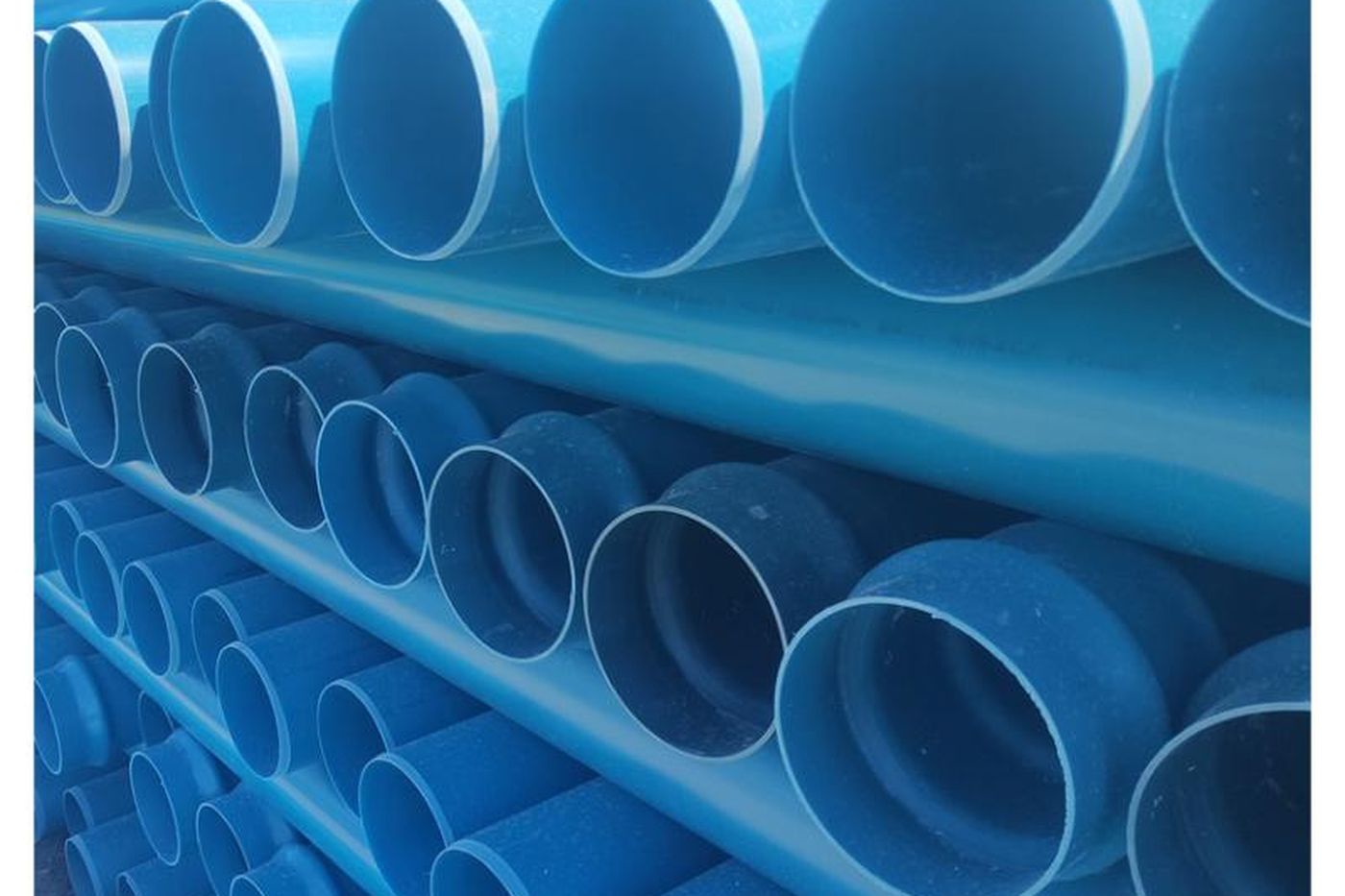
Integral rubber-ring socket
The standard joint for PVC-O. The socket is formed during orientation, the elastomeric seal is factory-fitted, and assembly is a push — no cement, no cure time, no weather window. Handles thermal movement and ground settlement.
Flanged transition
Stub flange and backing ring at pumps, valves, flow meters and steel tie-ins. Drilling to the project's nominal pressure class.
Mechanical / compression coupler
For repair and for tying into existing mains of a different material. Useful where a section has to be cut in without draining the line.
Not solvent-cemented
Solvent cement is not the intended joint for oriented PVC and we do not recommend it. If a cement joint is unavoidable on a transition, use a PVC-U spigot piece and cement on that.
Handling & installation notes
- BeddingThin wall means lower ring stiffness: bed and surround matter more than with PVC-U, and the trench bottom needs to be free of sharp rock
- DeflectionCompact the haunch zone in lifts; do not rely on the pipe to carry point loads from backfill
- UVStore under cover. Long-term outdoor exposure discolours the surface; it does not change the pressure rating, but it does not help the sale either
- CuttingCut square with a wheel or guillotine, chamfer the spigot, mark the insertion depth, then push home — the ring does the sealing, not force
- Pressure testHydrostatic test per the project specification after the trench is backfilled in sections, with the joint exposed at each test length
Quality documents per shipment
- Mill test cert.Compound batch, orientation line, dimensions, hydrostatic result
- Dimensional reportOD, wall thickness, ovality and socket depth sampling per run
- Impact testFalling-weight result at the specified temperature, per batch
- Packing listBundle count, length, net / gross weight, container plan