
Parts that don't
come off a shelf
A catalogue covers the joints a project expects. The joints that stop a line being commissioned are the ones nobody stocks — the 1,400 mm reducer, the D-section that has to sit flush against a tunnel wall, the elbow that replaces a welded assembly with one machined piece.
Four jobs a standard
fitting cannot do
Most custom enquiries arrive for one of these reasons. If yours is one of them, the drawing is all we need to start.
Outside the moulded range
Above roughly DN630, moulded fittings stop. Beyond that the options are a welded fabrication or a machined part — and the choice changes the pressure rating.
A profile, not a circle
D-section pipe for flush wall mounting, flattened sections for confined trenches, profiled wear strips. None of these exist in a pipe catalogue.
One weld too many
A fabricated elbow carries a seam in the highest-stress zone of the line. A machined elbow from solid stock does not, so the joint does not need derating.
One-off replacement
A plant needs a single part to get back online. No tooling budget, no minimum quantity, no wait for a mould to be cut.
Three ways to make
the same part
The same drawing can be produced three ways, and they are not interchangeable on cost, lead time or pressure rating. Choosing between them is the part of custom work that actually needs judgement.
| Decision | CNC machined | Fabricated (welded) | Injection moulded |
|---|---|---|---|
| Best for | Profiled sections, one-piece elbows, large reducers, replacement parts | Oversized tees, bends and spools beyond mould capacity | Repeat orders of small and medium fittings |
| Tooling cost | None | None | Mould required |
| Minimum quantity | 1 piece | 1 piece | Batch, to amortise the mould |
| Weld seam | None | Yes — NDT on request | None |
| Material yield | Low — cut from stock | High | High |
| Lead time | Shortest — nothing to cut first | Medium | Longest — mould before parts |
We recommend the process, not the one with the best margin. On a one-off part that usually means machining; on a programme of 500 identical tees it usually means a mould.
From stock bar
to finished part
Solid PE rod is extruded up to φ1,390 mm specifically so that large parts can be cut from it rather than welded up from sheet.
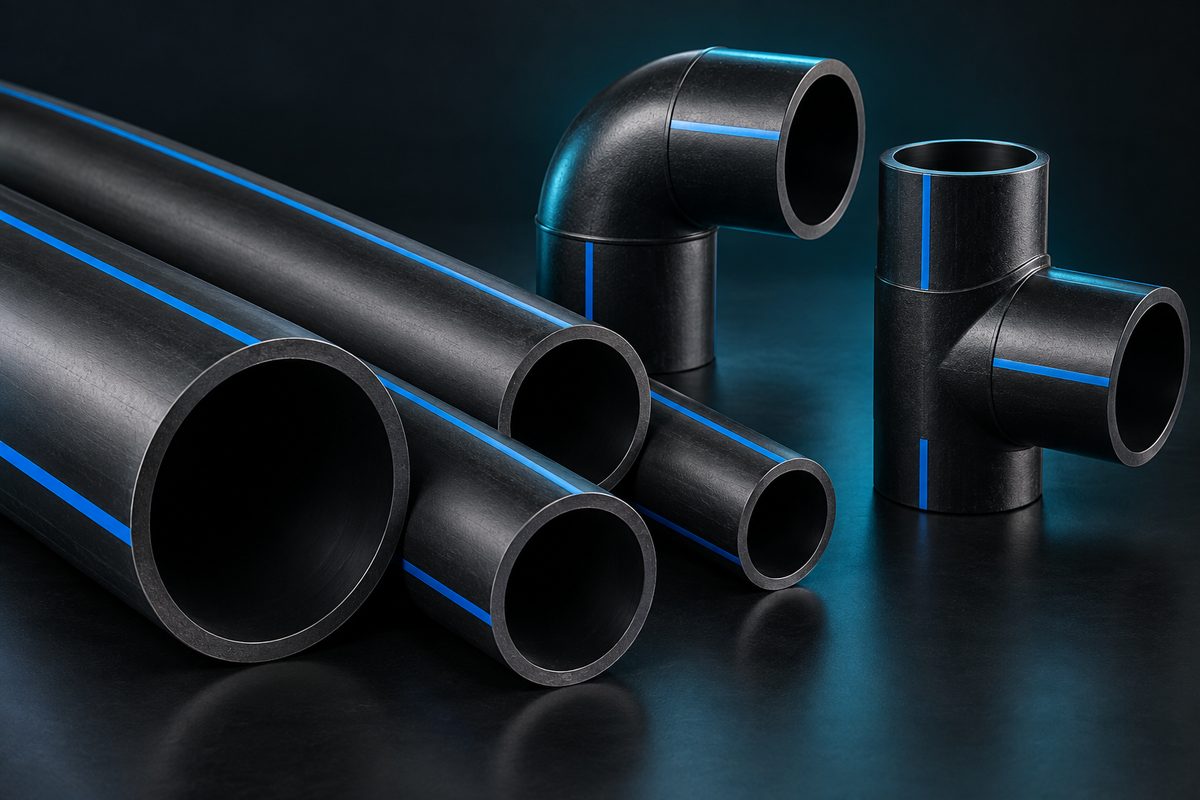
- Solid rod & thick-wall stockφ20 – φ1,390 mm, the raw material for machined parts.
- One-piece elbowsMachined from solid, any angle, no seam in the throat.
- D-section & profiled pipeFlattened or shaped sections for flush and confined installations.
- Concentric & eccentric reducersLarge-bore transitions, machined or fabricated.
- Flanged spools & stub endsDrilled to ASME B16.5, EN 1092 or the client's own pattern.
- Wear pads, sheeting, machined plateCut and profiled to drawing for chute and hopper lining.
What we need from you,
and what comes back
Drawing or sketch
A dimensioned PDF, a STEP file, or a photo with three critical dimensions marked. All three work.
Service conditions
Media, pressure, temperature and whether the part is buried, exposed or clamped. This decides wall section, not the drawing alone.
Process proposal
We come back with the route, the price and the lead time — plus a note if a standard part would do the job more cheaply.
First article, then batch
One piece is produced and measured against the drawing for your approval before the balance runs.
Send the drawing. We will tell you how to make it.
PDF, STEP or a dimensioned photo. You get a process recommendation, a price and a lead time — and a straight answer if a catalogue part already does the job.